Your Road Through This Course
The bootcamp's four modules build the stack one layer at a time, from your first line of C# to a secure Angular app talking to your own web API and database, online in Azure.
Novice · Web Development · Software Development · Updated
After this lesson you can
- Match each module of the course to the layers of the stack it teaches
Key takeaways
- The course builds the stack in order. C# and the database come first, then server code, then web APIs, then the Angular front end.
- Every module adds to the last, so the C# you write in week one is the same C# behind your web API in Module 3.
- Most chapters end with an exercise you build yourself, and the last chapters bring every layer together in one app.
- By the end you can build a full-stack app, from the database to the screen, and put it online.
A long course is easier when you can see the whole road. This lesson is the map: what each module teaches, which layer of the stack it builds, and what you'll be able to do at the end of it. Come back to it whenever you want to see how far you've come.
The order, and why
You might expect a full-stack course to start with the screen, since that's the part you can see. This one starts underneath, for a good reason: every layer stands on the one below it. The back end is written in C#, so C# comes first. The back end reads and writes the database, so the database comes next. The front end shows what the back end sends it, so it comes last, when there's something real to show. It's the same reason a house is built from the foundation up, even though the roof is what you see from the street.
The four modules
| Module | What you learn | The layers it builds |
|---|---|---|
| 1. Introduction to Programming | Your tools, then C# from your first program to classes and collections. SQL Server and T-SQL. Connecting a C# app to a database. HTML, CSS and Bootstrap. Your first ASP.NET Core MVC web app. | All three, for the first time: a web page built by C#, reading a real database |
| 2. Mastering Fundamentals | Unit tests, inheritance, polymorphism and dependency injection. Joins, views, stored procedures and database design. Data access with Dapper. MVC in depth. | The back end and the database, deeper: code that is tested and well organized, and a database you design yourself |
| 3. Full Stack Development | Interfaces, files and exceptions, LINQ. HTTP and web APIs with ASP.NET Core and Entity Framework Core. Calling APIs from C#. JavaScript in the browser: the DOM, events and fetch. | The back end as an API, and a front end in JavaScript that calls it |
| 4. Front-End Frameworks (Angular) | TypeScript, then Angular: components, signals, services, HTTP and routing. Securing a full-stack app. Professional topics, ending with putting your app online in Azure. | The front end as a full app, joined to your API and database, secure and online |
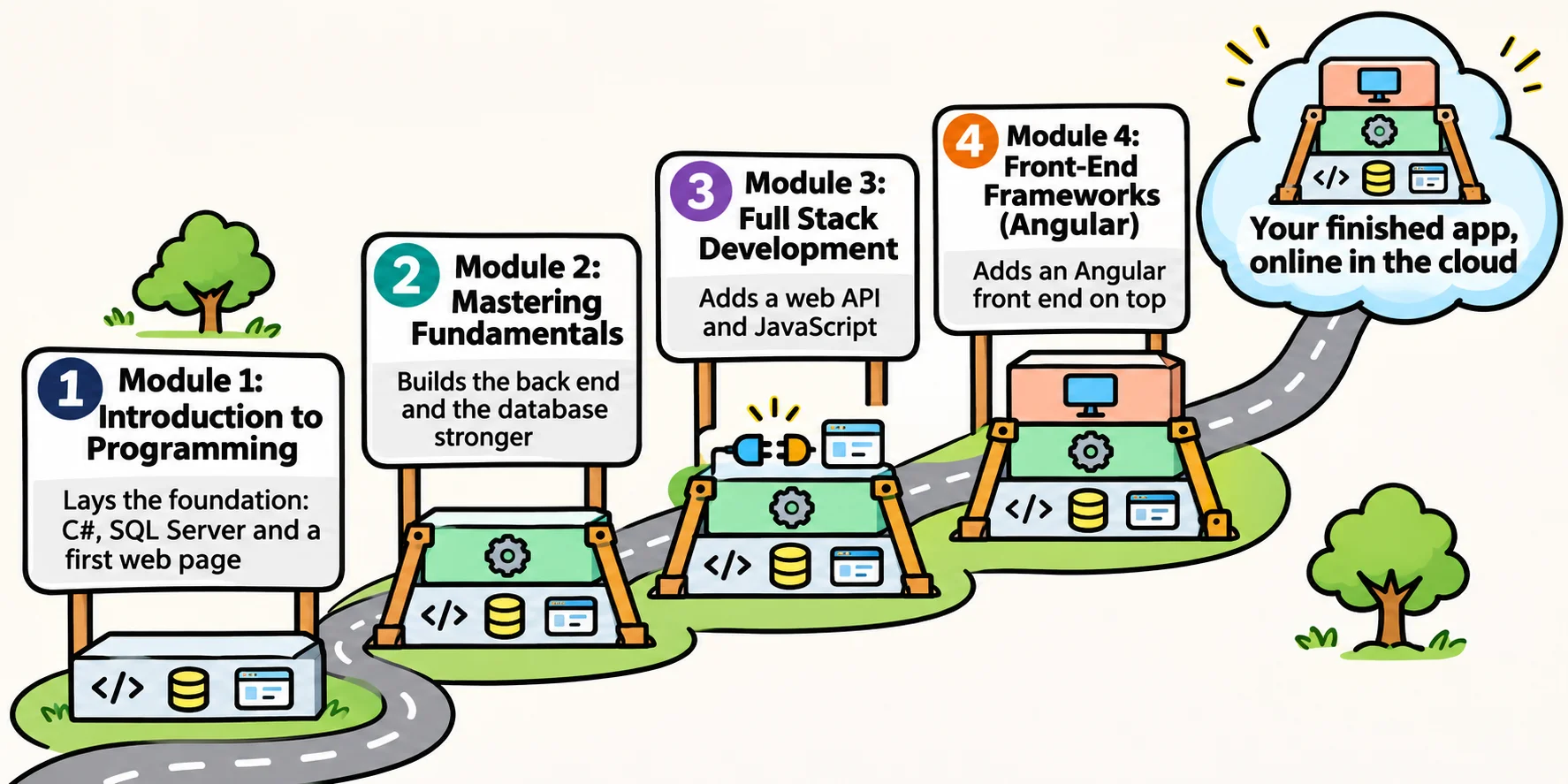
What you'll build on the way
You learn each idea by building with it. Most chapters end with an exercise: a real problem, starter code, and checks that tell you when you've got it right. A few of the stops along the road:
- Module 1: the C# code that reads and saves a bookstore's books, categories and customers in SQL Server (Exercise: Connecting an App).
- Module 2: the Build-It Pizzeria database, designed and built by you (Exercise: Build-It Pizzeria).
- Module 3: a web API for Northwind's products, so other programs can read and change them (Exercise: Northwind Web API).
- Module 4: an Angular front end for that products API (Exercise: an Angular Client for a Web API), then the same app with users who sign in, where only a signed-in user can add, change or delete a product (Exercise: Secure the App).
The last one is the whole stack in one app: Angular on the screen, your C# API behind it, SQL Server underneath. That's the full-stack developer from the first lesson of this chapter, What is a Full Stack Developer?, and by then it's you.
How to get the most from it
- Go in order. Each chapter uses what the earlier ones taught.
- Type the code yourself rather than copying it. Your fingers learn things your eyes skip.
- Do the exercises, even when the lesson felt clear. Building is where it sticks.
- Expect some days to be hard. Everyone who learned this had days when nothing worked. "I don't get it yet" is a normal part of the road, not a sign you're on the wrong one.
The next chapter, Introduction to Tools, sets up your computer with everything the course uses, and its lesson Lessons, Check Yourself, Exercises and Quizzes shows how lessons, practice and quizzes work on this site.
Check yourself
1 question to try on the lesson page.
So what
You now know where the road goes and why it goes in this order, so every chapter from here on is one more piece of an app you'll be able to build from end to end.
Key terms
- Full-Stack Developer
- Technology Stack