MySQL vs. SQL Server: the same jobs, different functions
Trim a name, round up to whole cartons, count the days an order was late. MySQL and SQL Server both do these jobs, but often with different words, and a few look alike while doing different things.
By Gregor Dzierzon ·

Learn SQL on one database and you'll soon meet the other. A class teaches MySQL, and your first job runs SQL Server, or the other way around. The good news: SELECT, WHERE, JOIN and GROUP BY read the same in both. The surprises are in the built-in functions, the small tools that clean up text, round numbers and work with dates.
Here are the everyday jobs side by side, then the five differences most likely to trip you up.
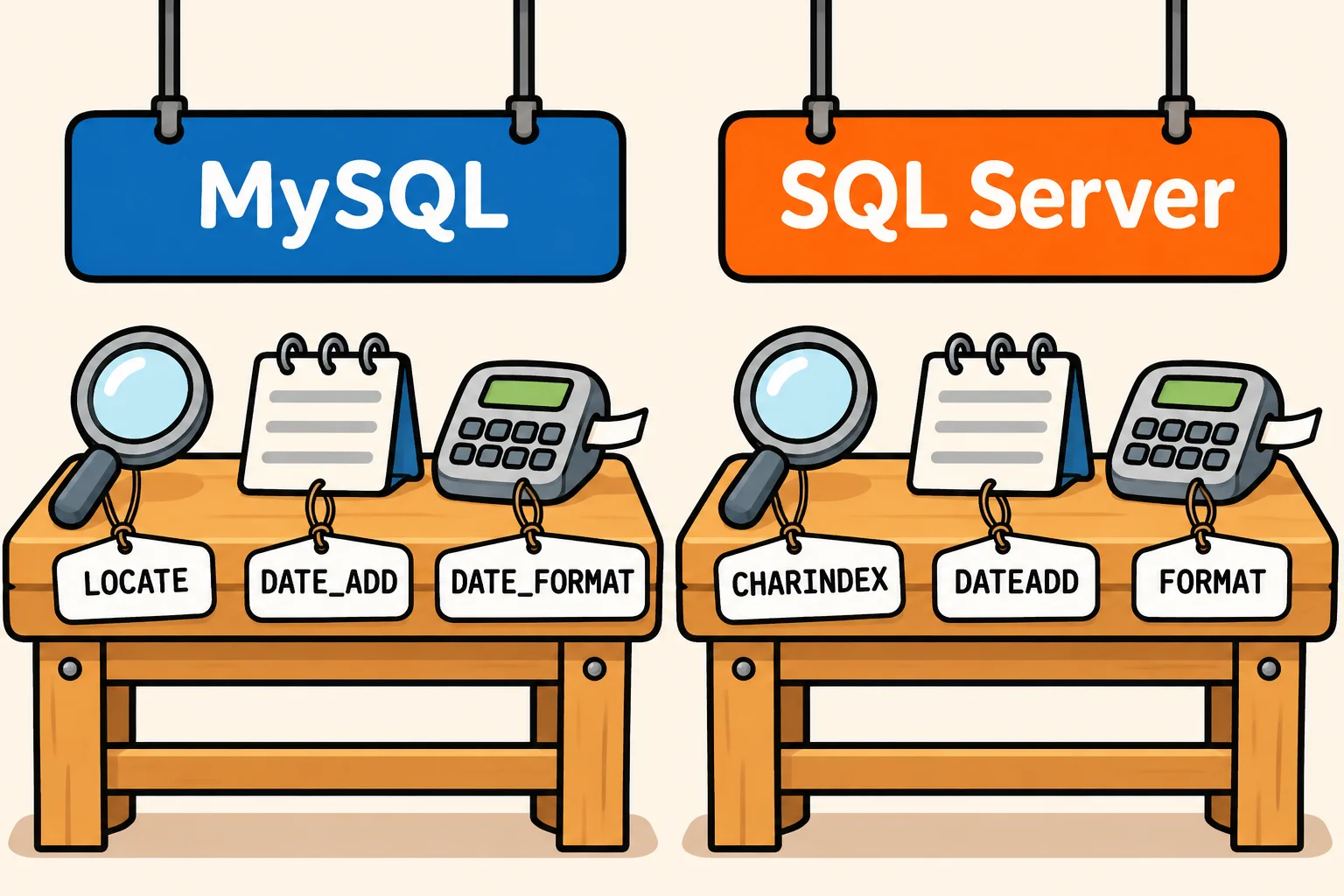
The same jobs, side by side
| The job | MySQL | SQL Server (T-SQL) |
|---|---|---|
| Remove spaces at both ends | TRIM(text) |
TRIM(text) |
| Swap one piece of text for another | REPLACE(text, find, new) |
REPLACE(text, find, new) |
| Find where a piece of text is | LOCATE(find, text) |
CHARINDEX(find, text) |
| How many characters | CHAR_LENGTH(text) |
LEN(text) |
| Round up, round down | CEILING, FLOOR |
CEILING, FLOOR |
| The date and time now | NOW() |
GETDATE() |
| Days between two dates | DATEDIFF(later, earlier) |
DATEDIFF(day, earlier, later) |
| A date 30 days later | DATE_ADD(d, INTERVAL 30 DAY) |
DATEADD(day, 30, d) |
| A date as text for people | DATE_FORMAT(d, '%M %e, %Y') |
FORMAT(d, 'MMMM d, yyyy') |
| A stand-in for NULL | IFNULL(x, 'n/a') or COALESCE |
ISNULL(x, 'n/a') or COALESCE |
Both databases count text positions from 1, not from 0 as Java and C# do: the space in Maria Anders is at position 6 in both. And some functions are spelled the same everywhere, COALESCE, NULLIF, UPPER, LOWER, ROUND and ABS among them.
Five differences that bite
1. DATEDIFF takes its dates in opposite orders. In MySQL the later date comes first and the answer is always in days: DATEDIFF('2026-03-18', '2026-03-16') is 2 (MySQL manual). SQL Server names the unit first, then the earlier date: DATEDIFF(day, '2026-03-16', '2026-03-18') is 2 (Microsoft Learn). Copy one into the other without swapping and every late order looks early.
2. CONCAT and NULL. Building a label from a city and a region, where the region is NULL:
-- MySQL: NULL, the whole label is gone
SELECT CONCAT('Berlin', ', ', NULL);

-- SQL Server: 'Berlin, ' (the NULL counts as empty text)
SELECT CONCAT('Berlin', ', ', NULL);
MySQL's CONCAT gives NULL if any part is NULL (MySQL manual); SQL Server's treats a NULL as empty text (Microsoft Learn). Both have CONCAT_WS(', ', city, region), which skips the NULLs and leaves no stray comma.
3. ISNULL means two different things. In SQL Server, ISNULL(region, 'n/a') supplies a stand-in (Microsoft Learn). In MySQL, ISNULL(region) takes one value and answers a question: 1 if it's NULL, 0 if it isn't (MySQL manual). COALESCE(region, 'n/a') works the same in both, so it's the one to reach for.
4. Dividing whole numbers. The warehouse packs 12 units to a carton, and a product has 39 in stock. In MySQL, 39 / 12 is 3.2500, so CEILING(39 / 12) is the 4 cartons you need (MySQL manual). In SQL Server, 39 / 12 is 3, because dividing two whole numbers drops the remainder (Microsoft Learn), so CEILING(39 / 12) is 3, one carton short. Write 39 / 12.0 and SQL Server gets 4 too.
5. Letter case in REPLACE. MySQL's REPLACE matches letter case exactly, so REPLACE('Chai', 'c', 'k') changes nothing (MySQL manual). SQL Server compares text by the database's collation, and the usual one ignores case, so the same call gives khai (Microsoft Learn).
A habit that travels
When a function is spelled the same in both, prefer it: COALESCE over IFNULL or ISNULL, CONCAT_WS when parts might be NULL. When it isn't, keep the other database's spelling in mind, and test the edge cases (a NULL, a 0, the last day of a month) on the database you're really using.
Go deeper
Each database gets a full lesson, with the problem each function solves, the Northwind sample data, a practice box and questions to check yourself:
- More MySQL Functions, in the Java Full-Stack Bootcamp
- More T-SQL Functions, in the C# Full-Stack Bootcamp
On one page: the MySQL vs. SQL Server functions cheat sheet, to keep or to share.
Sources
- Oracle, Date and Time Functions, MySQL 8.4 Reference Manual:
DATEDIFF(later date first, in days),DATE_ADD,DATE_FORMAT,NOW. - Oracle, String Functions and Operators, MySQL 8.4 Reference Manual:
CONCATgivesNULLif any part isNULL,CONCAT_WS,REPLACEmatches case,LOCATE,CHAR_LENGTH. - Oracle, Comparison Functions and Operators, MySQL 8.4 Reference Manual: MySQL's one-value
ISNULL()andCOALESCE. - Oracle, Arithmetic Operators, MySQL 8.4 Reference Manual:
/keeps the decimals. - Microsoft, DATEDIFF (Transact-SQL), Microsoft Learn: the unit, then the start date, then the end date.
- Microsoft, CONCAT (Transact-SQL), Microsoft Learn: a
NULLcounts as empty text. - Microsoft, ISNULL (Transact-SQL), Microsoft Learn: a stand-in for
NULL. - Microsoft, / (Divide) (Transact-SQL), Microsoft Learn: whole numbers divide to a whole number.
- Microsoft, REPLACE (Transact-SQL), Microsoft Learn: matching follows the collation.
Tags: mysql, sql, sql-server, t-sql